Claude Lanzmann directed this nine-and-a-half-hour film about the extermination of the Jews of Europe without using a single piece of archive footage. For 12 years, he interviewed survivors, eyewitnesses and former Nazis. Shoah is regarded by many as one of the most important works in world cinema. ‘Shoah’, the Hebrew word for‘Catastrophe’, refers to the extermination of six million Jews during the Second World War. The term ‘the Shoah’ has been used in Israel since 1948 and in Europe since the release of Claude Lanzmann’s film in 1985, whereas in the United States the word ‘Holocaust’ is used.
In 2023, Shoah was inscribed on UNESCO’s Memory of the World Register. It thus joins a select group of works from the cinematographic heritage included in the Memory of the World collection, amongst which are the Lumière brothers’ archives, Fritz Lang’s Metropolis, Luis Buñuel’s Los Olvidados and the complete films of Ingmar Bergman. A seminal work of history, Shoah also joins The Diary of Anne Frank, the archives ofthe Warsaw Ghetto, those of the Auschwitz trials and the collection of testimonies at Yad Vashem. History retains very little from thecenturies. The 20th century is the century of the Shoah; it is also the century of cinema. Its inclusion on UNESCO’s Memory of the World Register confirms the unique place of this masterpiece at the intersection of art and history.


In 2013, Shoah was re-released in cinemas in a digitised and restored version. The film has been available on DVD in this new version since March 2016. From an aesthetic point of view, the high-definition digitisation has made it possible to reproduce the film’s faces andlandscapes in all their nuances. A subtle restoration process was carried out to respect the original footage without ‘sanitising’ it. Digitisation also facilitates the film’s distribution, as it can now be screened much more easily in cinemas equipped with digital projectors. Finally, this digitisation ensures the film’s optimal preservation, a particularly crucial consideration for a work of this nature. The film Shoah was digitised and restored by L'Immagine Ritrovata with the support of the CNC and the Fondation pour la Mémoire de la Shoah.
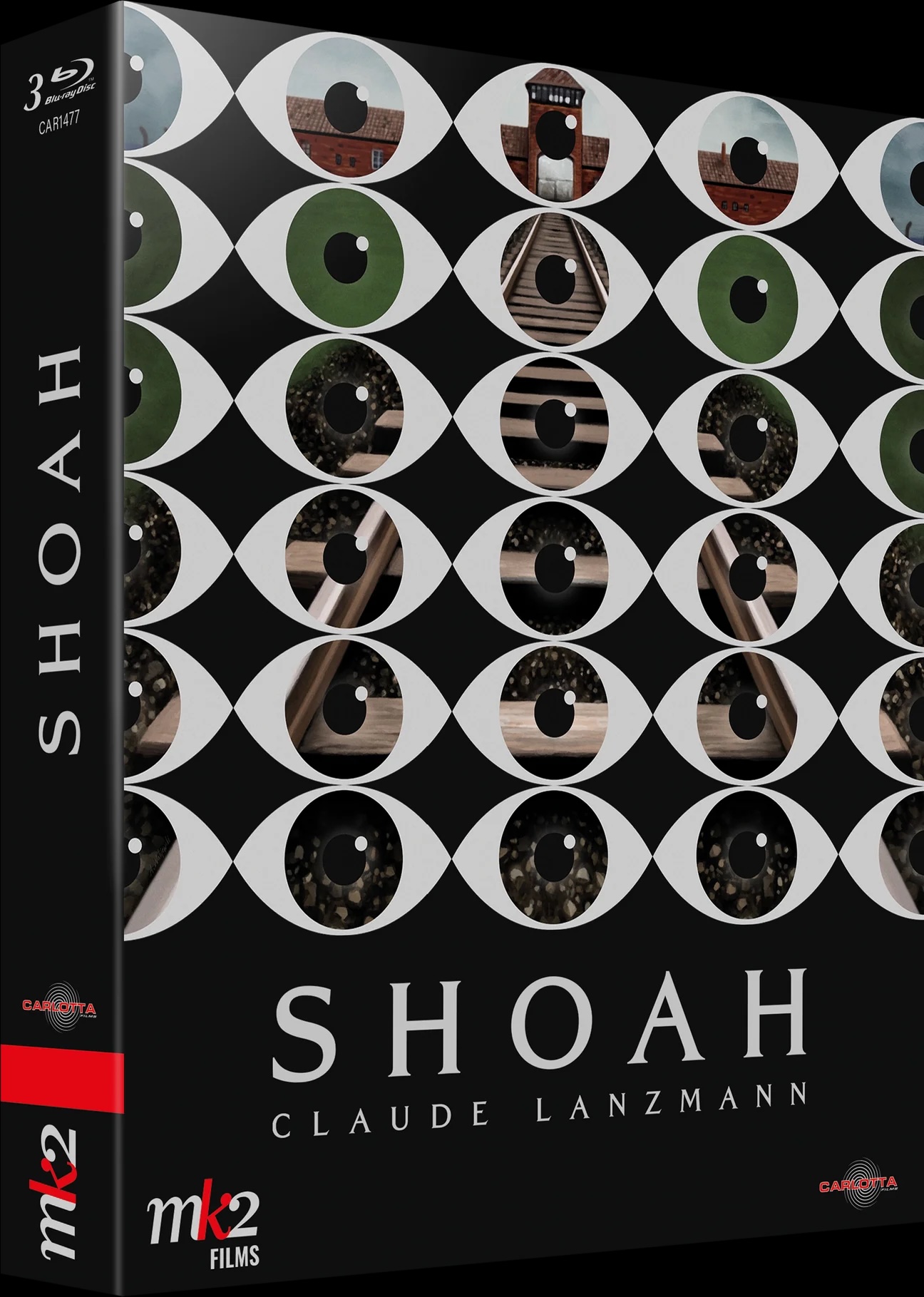
mk2 is representing six films by Claude Lanzmann. The distributor was behind the design of the new poster for Shoah. It is the work of the renowned Polish designer Aleksander Walijewski. The illustration emphasises that it is only through the collective gaze of the many individuals featured in the film, throughout its nine hours and thirty minutes, that it is possible to begin to understandthe true nature of the Holocaust. mk2 Films is also releasing a new trailer for Lanzmann’s Shoah.
Dominique Lanzmann, the director’s widow, and the INA have sought to provide teachers and pupils with key extracts from Shoah that are of great educational value. This enables the educational community to engage pupils in reflection on the systematic extermination of the Jewish people during the Second World War and onother recognised genocides, in line with the school curriculum. Lumni Enseignement therefore offers six extracts from Shoah. Selected by Claude Lanzmann himself for educational use, each extractis designed to fit within a one-hour lesson. The platform, publishedby the INA, offers these sequences with all the site’s advanced features: they are fully chaptered, transcribed and synchronised. They are also accompanied by an educational booklet written byJean-François Forges, a history teacher, in 2001. Produced as part of a project carried out for the National Institute for Educational Research – now the French Institute of Education – the booklet was updated in 2021 to reflect the latest developments in historical research.
Archival material relating to the making of Shoah has been donated to various institutions in different countries.
Just as the film Shoah draws on archive material and testimonies gathered from different countries and continents, in different languages, the physical traces that tell the story of its creation are also scattered across the globe.
These donations thus pay tribute to the resolutely international nature of Claude Lanzmann’s work and help to raise awareness of his work beyond our borders. This network of institutions, each holding apart of the Shoah archives, encourages their dissemination, translation and study throughout the world.
All of them are listed on UNESCO’s Memory of the World Register, just like the film Shoah.